
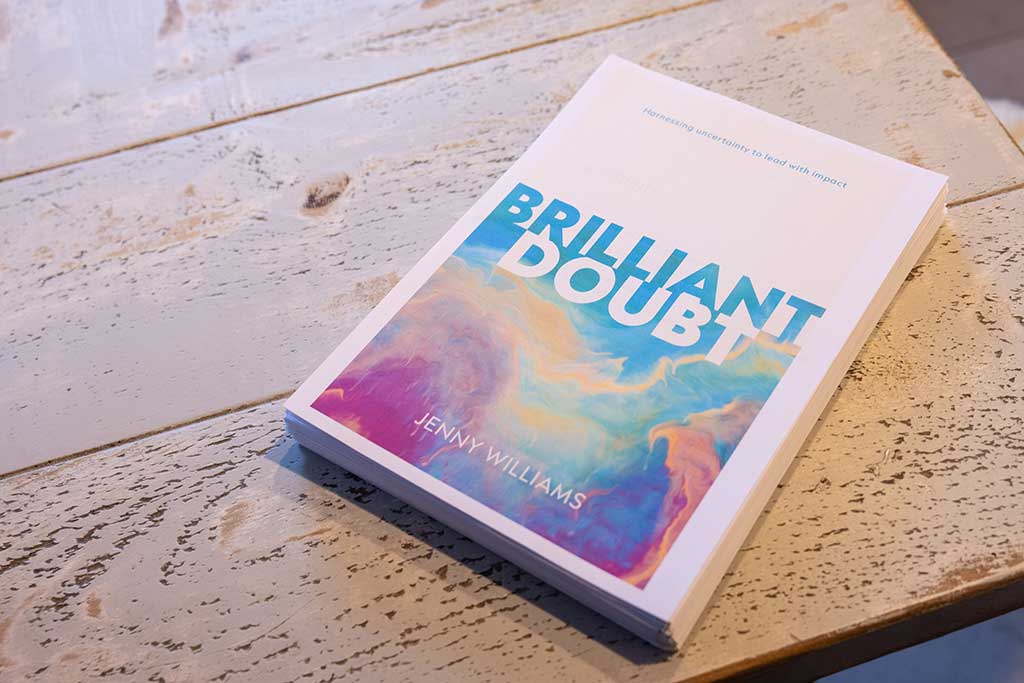
In the first piece in this series, I explored how doubt shows up in professional life – in ourselves, in situations, and in the systems we’re part of. This piece is about what happens next: what it looks like when doubt becomes active.
Summer 2025 was not a happy time.
Doubly disappointing as Summer is normally a happy place for me; I always work less – you can’t fight the school summer holidays, so you may as well kick back and relax, plus it’s my birthday and I believe strongly in celebrating me. Go big or go home is the maxim.
But here I was not happy.
I was deep in doubt – literally and metaphorically. Literally, because I was going through the editing process of my book – Brilliant Doubt, which was not going well. There was a big gap between my expectations of editing and the edit I received back from the publisher. Now I am a first-time author, and I didn’t know what I didn’t know. And that’s on me, not my publisher. However, I received the lightest touch of editing back on my draft. I know I am good at concepts. I am less good at stringing it together into grammatically coherent sentences. If you think I am being hard on myself, this was also the feedback from the development editor I had worked with earlier. So, when the manuscript came back largely untouched, the doubt alarm bells were ringing loudly. You couldn’t make it up; there I was writing about doubt and waist deep in my own. Double doubt. Not a place I wanted to hang out.
I was experiencing the side of doubt we are perhaps most familiar with – the side that invites overthinking, procrastination, and worry. The kind that stalls and drains energy rather than directs it. It makes us inactive.
And yet through my research, my coaching work and my own writing, I know there is another side to doubt. One we rarely talk about.
I call it Active Doubt.
Most of us experience doubt in its inactive form. The looping kind. The internal questioning that sounds busy but goes nowhere. The version of doubt we try to override with confidence, silence with reassurance, or simply push through.
But Active Doubt is different.
Active Doubt is doubt that is no longer passive or paralysing, but alert, intentional, and constructive. Doubt with its sleeves rolled up.
Active Doubt doesn’t ask, “What’s wrong with me?”
It asks, “What is this doubt trying to tell me?”
That shift matters. Because when doubt becomes active, it stops being about your worth and starts being about the work.
In my case, the doubt wasn’t saying you shouldn’t be writing this book.
It was saying something far more practical: this draft isn’t yet explaining my ideas clearly enough.
And that matters. My thinking needs to be helpful. It needs to land. If I am not explaining myself clearly enough, then there is more work to be done. Once I really listened to that, the next steps became clearer. There were two things I needed to do.
First, I needed to rework the manuscript myself, taking a critical eye to it and once again be the first line of editing. But second, I needed another kind of intelligence in the room and that came in the form of Kirsty.
Kirsty is a guardian of logic and a stickler for grammar. I always open her feedback emails with a deep breath or put another way she tells me when I am talking nonsense. She ploughed through 50,000 words in a single weekend — challenging, shaping, and tightening the manuscript in exactly the way it needed. Her insight was invaluable. She surfaced inconsistencies I’d grown too close to see and helped craft the argument into something far more coherent.
That decision to bring her in was an act of Active Doubt.
Inactive doubt would have stayed internal: more worrying, more second-guessing, more late nights tinkering alone. Active Doubt moved outward. It asked: what would make this better? And then it acted.
Only then did the manuscript go back to the publisher for a second edit which was much stronger. Had I ignored my doubt, or tried to silence it with reassurance alone, the book would be far worse for it.
This is the heart of Active Doubt. It treats doubt as data, not a defect. It assumes doubt shows up for a reason — often because something important has been overlooked, rushed, or simplified too far. When we work with it, doubt sharpens thinking, deepens judgement, and raises the quality of outcomes.
Inactive doubt ruminates. Active Doubt moves.
Inactive doubt collapses inward. Active Doubt looks outward and asks better questions.
Inactive doubt attacks identity. Active Doubt focuses on task, context, and choice.
The issue is not doubt itself.
It is our failure to make it useful.
When doubt becomes active, it becomes a partner rather than a saboteur. It helps us course-correct, collaborate more intelligently, and act with greater integrity — particularly in complex professional environments where certainty is often performative rather than real.
Learning to make doubt active is not about becoming more hesitant.
It’s about becoming more precise.
Precision, not confidence alone, is what leads to better work, better leadership, and better decisions.
And everyone needs a Kirsty. None of us do our best work alone.
Bottom of Form
#activedoubt #impostersyndrome #professional doubt #leadership # leadershipdevelopment #selfdoubt #systemicdoubt #situationaldoubt