
We’re used to treating doubt as a problem – something to overcome, suppress, or fix. But in complex professional lives, doubt is not the enemy. It’s information often about who we are becoming.
In this series, Rethinking Doubt, I explore the different forms doubt takes – in ourselves, in leadership, and in the systems we’re part of – and how learning to work with doubt, rather than against it, can lead to better decisions, stronger leadership, and more humane organisations.
In the first piece, I explored how doubt shows up in professional life. In the second, I looked at what happens when doubt becomes active. This piece is about something more personal: what doubt is telling us about who we are becoming.
Who am I? A big question but one we rarely give much consideration to day to day.
To navigate it, we rely on a shorthand of labels: daughter, sister, godmother, business owner and so on. Labels which help fill in the outline of who we are. They give others and us a sense of who we are in the world. They can become shorthand for where we fit.
Then there are the labels that add a bit more colour to who we are: music lover, yoga hater, sweet toothed vegetarian and Mr Weller’s kahu (I have always preferred the Hawaiian label of kahu meaning dog guardian versus owner – there is a debate to be had if he owns me rather than other way round).
An old-line manager once described me as one of the most instinctive and creative marketers he had worked with. This self-proclaimed doubter was floored by this compliment. It’s an example of how the outside world can shape our thinking about ourselves and our identity. And it made me feel seen – like perhaps I took up more space than I thought.
I am instinctive; it helps me navigate through the world and be decisive. I create plans, powered by instinct. Creative, on the other hand, was something I aspired to be. I have a highly creative mother, but I did not see myself as that at the time. His label helped me glimpse what others might already see. He lightened the load of doubt that I was feeling about myself. A load which was heavy and had the potential to keep me in inactive doubt.
There are also the labels cast and shaped by the system we are a product of; the cultural and societal biases and prejudices built into it. When I worked in the family centric business of Mars Confectionery, I always felt awkward during introductions, knowing I didn’t fit the unspoken template of a husband and 2.2 children. Now they were all lovely people, but there was an unconscious bias towards a normative identity. When we don’t fit the perceived norm, it can bring doubt to how we see ourselves and others see us.
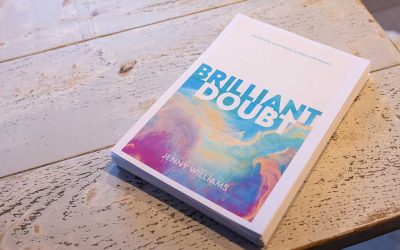
As one creative agency CEO I interviewed for Brilliant Doubt highlighted the challenge of identity and doubt is often amplified by race, gender, and belonging:
“There was a tonne of things that fed into my doubts: I don’t have the formal education that most of my peers have. I didn’t go to university. Lots of not feeling good or clever enough. There is something about being an immigrant – a woman of colour – where you’re constantly in rooms where you don’t feel like you belong because you don’t see other people like you…
If I’m honest, being a woman didn’t feel like a hindrance until I became a mum… Women do not succeed as mums — it’s very implicit.
You have to become comfortable with feeling uncomfortable — I talk about it all the time. We’re all uncomfortable, aren’t we? Even people who followed a standard path are out of their comfort zone now. The whole world has changed.”
All these pieces start to make up our story, a story which is created by us and the world we live in. The story becomes our identity.
And part of that story is our relationship with doubt.
“I’m an imposter.”, “I am full of doubt.”
Or the opposite — “I’m confident.” “I know what I want.” “I am good at X or Y”
When we put a hard edge around doubt it becomes a definitive part of who we are, and it also means we stop listening to its quiet whisper and what it has to offer. As the creative agency CEO mentioned “We are all uncomfortable”, we all have a relationship with doubt, the question is how we can evolve that relationship to make it healthy and to be able to access the good parts of doubt, the parts that give us curiosity, creativity, change and challenge.
Our relationship with ourselves shifts and morphs over time. When those labels no longer quite fit, doubt often rushes in to fill the gap. Doubt often appears not because we’re failing, but because the labels we rely on have hardened while our lives are trying to move.
I first encountered the idea of liminality in the work of Herminia Ibarra, Professor at London Business School. She uses the term to describe the uncertain, in-between period we experience during transitions — such as a career change where we no longer fully inhabit one identity, but have not yet stepped into the next. We are betwixt careers.
Liminality was a phase I recognised when I was trying to morph from marketer to Executive Coach.
A period where self-doubt was a constant companion:
Have I done the right thing?
What if I get no clients?
What if I am not successful?
A period where I hung in the doorway of doubt. Because identity is moving and context is shifting – doubt often shows up not as a sign that something is wrong, but as a signal that something is changing; perhaps we are trying something new.
Doubt is a process not a destination. How we integrate it as part of our identity is important. When doubt becomes a fixed label, it stops being informative and starts being limiting. However, our identity isn’t fixed. How many career changes have you had? Or life changes which have shaped your identity? Everyone’s identity is constantly evolving, whether we are conscious of it or not.
When doubt shows up or gets louder, it can be a sign that we are changing, that we are crossing a new threshold or entering unfamiliar territory. Not a failure, but a sign of movement.
Its arrival is often good news. It suggests we are stretching ourselves, testing something new, allowing identity to shift. Perhaps it’s time to see doubt not as a red flag to retreat from, but as a green flag, signalling learning, growth, and possibility.
Doubt is what we feel when a fixed identity meets a changing reality.
This is the doubt that doesn’t need silencing or fixing.
It needs understanding.
Consider:
- Who are you in this relationship with doubt?
- Who might you become if that relationship evolved?
- What is the green flag of doubt inviting you to pay attention to?
When we understand doubt in this way, we can access the positive, purposeful qualities of Active Doubt.
Photo courtesy of: Nick Fancher @Unsplash.com
#brilliantdoubt #leadership #leadershipdevelopment #activedoubt #impostersyndrome #selfdoubt #situationaldoubt #systemicdoubt